

How is the Examine website organized?
Examine is organized unlike any health information site you’ve seen, so read these basics before digging in!
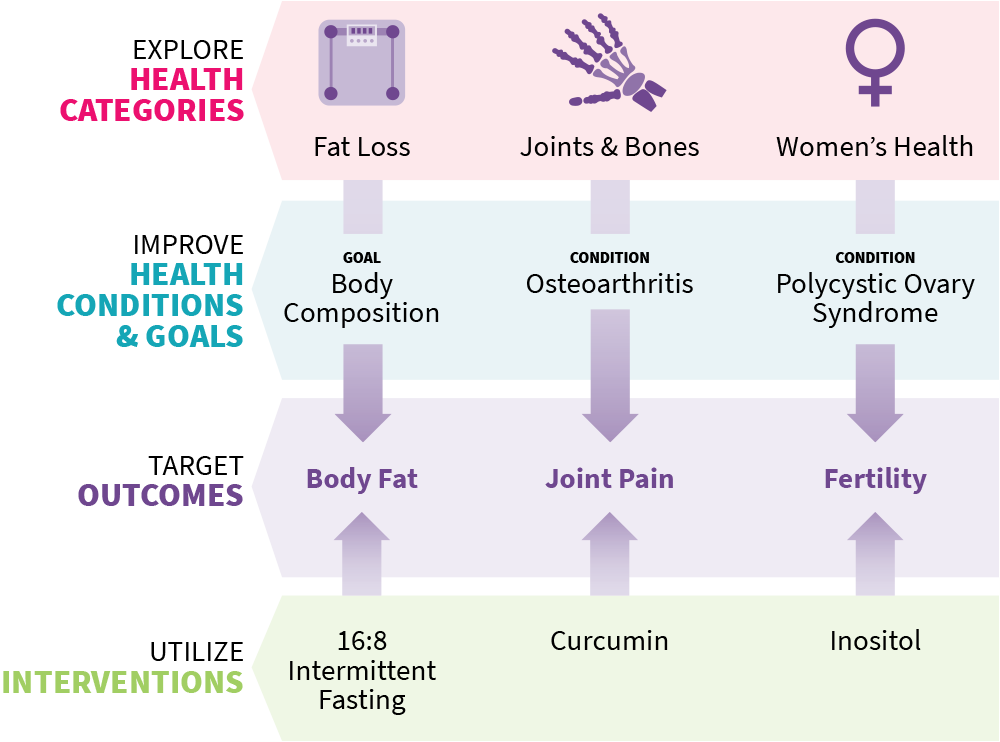
In scientific research, anything that’s tested in a trial is called an intervention. Fish oil, creatine, and low-carb diets are examples of interventions. Trials look at specific, measurable outcomes (such as LDL-C, skin elasticity, or self-rated anxiety) to see if an intervention “works”.
Examine covers 400+ health interventions and 700+ health outcomes. But people care about their health conditions and goals, not just specific outcomes. So we also have around 400 health conditions and goals pages.
The last (and broadest) part of the hierarchy is the health categories. On the upper left of any intervention or condition/goal page, you’ll see which of 25 health categories the page belongs to. The category pages are the backbone of Examine 2.0 — they collect all the related FAQs and study information in one place.
This is a lot to take in! So here’s a simple way to think about it: If you have a health condition or a health goal, you’re interested in what interventions might improve the outcomes related to this condition or goal. And since there are so many conditions and goals out there, we grouped them under 25 broad health categories to make the website easier to use.
What’s the best way to use Examine on my mobile device?
You can add the Examine icon to your app home screen for easy access. Examine 2.0 works great on mobile! Follow this easy guide to add Examine to your home screen.
What’s the best way to find the answers to my questions?
Use the search bar and ExamineAI!

The search bar is integrated across the site and digs through every page we’ve published. If you still can’t find what you’re looking for, just ask ExamineAI, our large language model trained exclusively on Examine’s extensive archives. It’s integrated in the search results that appear when you type, located at the bottom. Learn how to use ExamineAI.
How are individual Examine pages set up?
Most pages on Examine are split into two main parts: FAQs (the questions our readers want us to answer) and the Examine Database (the randomized trial data we systematically collect).
The first few FAQs on a page give you standardized information about the topic at hand. The specific type of information differs by page type.
So the first few condition page FAQs will let you know about signs and symptoms as well as common treatments, whereas those on intervention pages will tell you about potential benefits and harms of that intervention.
After those introductory FAQs, you’ll often see an Examine Database. It contains all the randomized trial data we’ve collected on the topic at hand. The purpose of the Examine Database is to provide a systematic and comprehensive source of data, so that you can see how a trial fits into the full body of research on a topic instead of just a few cherry-picked studies.
As a disclaimer of sorts, note that we’re always updating the trials in the Database. Examine has many hundreds of pages, and it takes some time to extract data from studies and add it to the Database. We also make errors at times, which we try to fix as soon as we find them or are notified!
Next, you may see a research feed that contains summaries of the newest studies, hot off the press. Finally, you’ll see even more FAQs on some pages. These FAQs provide more nitty gritty information, and we’ll be adding more and more of them to pages that don’t currently have many FAQs.
Is Examine still useful if I’m not versed in science?
You might be intimidated by this huge, science-heavy website! We’re always trying to improve and revise our writing to make it more accessible by people without science backgrounds. But in the meantime, here are a couple things to note.
First, the first few FAQs on each page cover basic information that lays the groundwork for more detailed information further down in the page. If you understand these basic FAQs, you understand more than 95% of people out there!
Second, you can incrementally learn more about science and the research process, starting with our guide on How to Read Research. Given that there’s so much research produced each month and so many scientific disciplines, no single person understands everything. So you’re a learner just like all of us at Examine!
What method does Examine use to grade evidence?
We use an algorithm that incorporates the consistency of evidence (how often trials agree with each other about potential benefit) as well as the magnitude of effect (how large of a change was seen in trials).
How do I ask Examine a question? How do I lavish Examine with praise? How do I critique Examine and tell them everything they’ve so obviously gotten wrong?
Try to be gentle – we’re working hard to be as accurate and useful as possible, but we do err at times (as does everyone, right?). We don’t always have time for long back and forths about every single issue, but do welcome additional perspectives.
If you like the site, let us know! We love praise (as does everyone, right?).
And if you wish to know more: click here to explore our plans and pricing.